
“The Big Bang theory does not conflict with the notion of God as creator. On the contrary, it may even support it, for the universe could not have created itself.” – Stephen Hawking
Tengrism is an ancient Turkic religion that centers on the belief in a supreme being, Goktengri, who is regarded as the creator and ruler of the universe. The religion’s cosmology posits that the universe was created from a single source of energy, light, and wisdom. This belief is consistent with the Big Bang Theory, which explains the creation of the universe as an explosion of energy from a single point, followed by the formation of matter and the expansion of the universe. Therefore, Tengrism and the Big Bang Theory align perfectly in their description of the origins of the universe.
In Tengrism, the Sky-God (Goktengri) is seen as the singular source behind the design, creation, and movement of the cosmos. Goktengri is believed to have created the universe from a single point of light, which expanded and formed the stars and galaxies. Similarly, the Big Bang Theory posits that the universe began as a singularity, a point of infinite density and energy, which expanded and formed the universe we see today. Thus, both Tengrism and the Big Bang Theory describe the universe as originating from a single source.
Tengrism’s emphasis on the unity and interconnectedness of the universe also aligns with the Big Bang Theory. According to Tengrism, all things in the universe are interconnected, and the movement and balance of the cosmos depend on the harmony between all things. The Big Bang Theory similarly describes the universe as a complex system of interconnected parts, with the movement and evolution of each part affecting the whole. Therefore, Tengrism and the Big Bang Theory share a common view of the universe as a unified and interconnected system, governed by a singular source of energy, light, and wisdom.
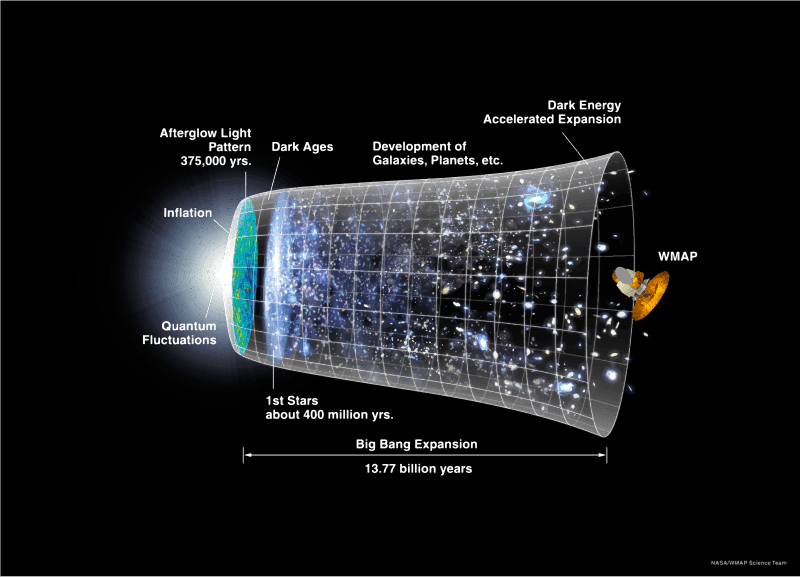
The Big Bang Theory has often been used to support the concept of deism, which posits that a supreme being created the universe but does not intervene in its ongoing operation. The theory explains the creation of the universe from a single source of energy and matter, which can be seen as evidence of a deliberate creation by a higher power. The scientific evidence supporting the Big Bang Theory suggests that the universe began with a burst of energy and matter, which then expanded and formed the cosmos we see today. This aligns with the deist belief that a supreme being created the universe and set it in motion, but does not interfere with its ongoing operation.
Tengrism, an ancient Turkic religion, shares similarities with deism in its belief in a supreme being, Goktengri, who created and oversees the universe. However, unlike deism, Tengrism also includes a belief in divine intervention in the form of shamanistic practices and the worship of spirits. Nonetheless, the concept of a supreme being who created the universe and then allowed it to operate according to natural laws resonates with the theological basics of Tengrism. The emphasis on the interconnectedness and harmony of the universe in Tengrism also aligns with the scientific understanding of the universe as a complex and interdependent system. Therefore, while Tengrism differs from deism in some aspects, the basic theological principles of both resonate with the scientific probability suggested by the Big Bang Theory.

The Tengrist Society © 2025
 The Tengrist Society